The knowledge worker is dead, long live the strategic worker.

We are in the midst of a secular shift in labor which is being driven by both rising interest rates and technology.  As I’ve already shared, physicians are not immune to either of these forces.  Envision has recently filed for bankruptcy and ChatGPT is going to have a profound impact on radiologist certification and value (coauthor Lincoln Berland).  The era of the “knowledge worker”, promoted by the 1960’s leadership guru Peter Drucker, is likely dead.  As physicians are largely knowledge workers (radiologists particularly so) is time to reinforce how we can create value.  My niece is a perfect case study.    

When I finished high school in 1990, public school superintendents trumpeted their college acceptance rates (with no follow-up on how many actually finished).  The message was if you didn’t go to college then you were a second-class member, you didn’t belong, you were a failure.  Today, not a moment too soon, this perception is changing.  

My niece Libby, for whom the traditional classroom was never attractive, has been fortunate enough to have the option to obtain her EMT certification during her last two years of high school.  She will graduate with a tangible skill which is desperately in need within our communities, a strategic long-term win-win deal for taxpayers.  During a recent practical ride-along with a local EMT squad she helped pick a woman off the floor and place her broken arm in a sling.  The feedback of “Oh, this is the first time I haven’t been in pain in hours,” is invaluable to a student like Libby.  For someone like myself who tries to help faceless patients at the edge of K-space and immunotherapy, it is also a lesson in humility.

As Libby graduates, she reached out to me to learn where she could buy a stethoscope.  Having two that haven’t been touched in 20 years, I offered her the one given to me at my medical school matriculation.  It will be infinitely more useful in her hands than it ever was in mine.  

This tangible tool being passed through the generations is also a signpost for our changing labor markets.  It will anchor Libby to a sustainable career by physically attaching her to the human beings who need her help.  Because of this tangible tether, she cannot be outsourced to AI nor is she at risk of being seen as too expensive as the cost of capital rises and some white-collar knowledge workers can no longer generate marginal value.  Her EMT certification is a gateway to future certifications as a medic or registered nurse, levering her value in our community for the taxpayers who have helped educate her.  Her certification is more valuable today than some bachelor degrees being handed out four years into the future. 

The labor teaching our children, responding to emergencies in our communities, fixing our plumbing and building homes, supplying our food, and working in recently onshored factories will be in demand.  Their jobs won’t be static, but will be there.  The rest of us, like Libby’s college bound twin, need to embrace the fact that the knowledge worker is dead.  We must become more strategic in our approach to our future careers.  We need to understand value, and iteratively ask ourselves whether we are delivering value.  In other words, we need to develop the professional sustainability skills that Libby is launching with.  

The knowledge worker is dead, long live the strategic worker.  There are several ways to be strategic in our workplaces, and one is our human networks.  Tangible tethers to other humans, like the stethoscope or a physical product delivered to a neighbor, will be difficult for either technology or rising capital costs to displace.  Strategic workers will recognize this fact and actively strengthen those networks.  
Am I Adding Value?

There is a great deal of paranoia among radiologists about being commodities.  This concern seems to surface repeatedly in journals and at open microphone sessions at the American College of Radiology annual meeting. Yet, the idea of a radiologist being a commodity is a fallacy due to a fundamental misunderstanding of the definition of a commodity.  A commodity is a fungible object that can be traded in a market with low transaction costs.  The two operative concepts in this definition are “fungible” and “low transaction costs”.

Our board certification process would have the appearance of making us fungible.  Is one board certified or CAQ’d radiologist the same as the next?  It depends on whom you ask.  A professional physician, nurse, or technologist knows this question is never true.  However I have first hand experience that schools teach hospital administrators that physicians are fungible.

A medical professional can quickly evaluate the manner in which a colleague cares for a patient and it is frequently unique.  However it take years to develop these perceptive skills.  For example, if you want to know who the best OB/GYN is in a town, ask the other physicians and nurses, you’ll probably find that they cluster with one or two choices.  A recent Harvard Business Review article entitled Why The Best Hospitals Are Managed by Doctors highlights the fact that medical professionals “know what ‘good’ looks like”.  The knowledge gap between experienced medical professionals and academically trained hospital administrators is tremendous.

A typical hospital administrator with no first hand knowledge of patient care and quality, frequently makes mistakes.  Administrators tend to rely on process metrics that only tell a part of the story and do not understand the concept of true quality. If we do switch into a management perspective and value radiologists along the operational priorities of costs, quality, flexibility, and timeliness; no two are alike.  For an administrator to think that one radiologist can be traded for another without a change in operations would be a grave mistake.

Commodities are traded for pennies; the trading of physicians is expensive and low transaction costs are not present in the marketplace.  Headhunter fees, moving costs, time spent on-boarding, credentialing, and decreased clinical productivity during the transition easily add up to over $100,000 for the typical physician.  Management must account for these costs when thinking of making a change.  However if an astute manager is threatening to replace a group or individual and is appropriately applying these concepts, then that incumbent needs to realize that they are not adding enough value and are in severe jeopardy.

Radiologists need to stop being concerned about being commodities and instead start to ask themselves about being expendable.  Every time a radiologist signs a report they need to ask, “Am I adding value?” If not and if done frequently, there are two possible outcomes. First that service may disappear entirely, which is why we have Appropriateness Criteria and computerized decision support. Alternatively for truly needed services, substitutions from other sources outside of radiology may be made.

There are many substitutions already present as well as new ones entering the marketplace.  Other specialists who want to read their own imaging exams are an example radiologists have continuously battled. The financially motivated behavior of self-referral is a negative economic force helping to keep this substitution in check.  Lately, artificial intelligence (AI) is another substitution that has received much attention.  In areas where radiologists are not adding value, AI is poised to replace that task.

A small amount of paranoia is healthy.  It forces individuals to survey their environment and make changes that improve survival.  Radiologists have never been commodities, but they do need to broaden their perception of the environment and marketplace.  If we do not want to end up like our former transcriptionists, radiologists need to perpetually ask, “Am I adding value?”

Patient Centered Screening for Lung Cancer

This month the Journal of the American College of Radiology features an outstanding article describing barriers to lung cancer screening in the context of behavioral economics. This article offers a nice complementary perspective to Porter’s Five Forces where lung cancer screening barriers are analyzed using an industrial economic model.

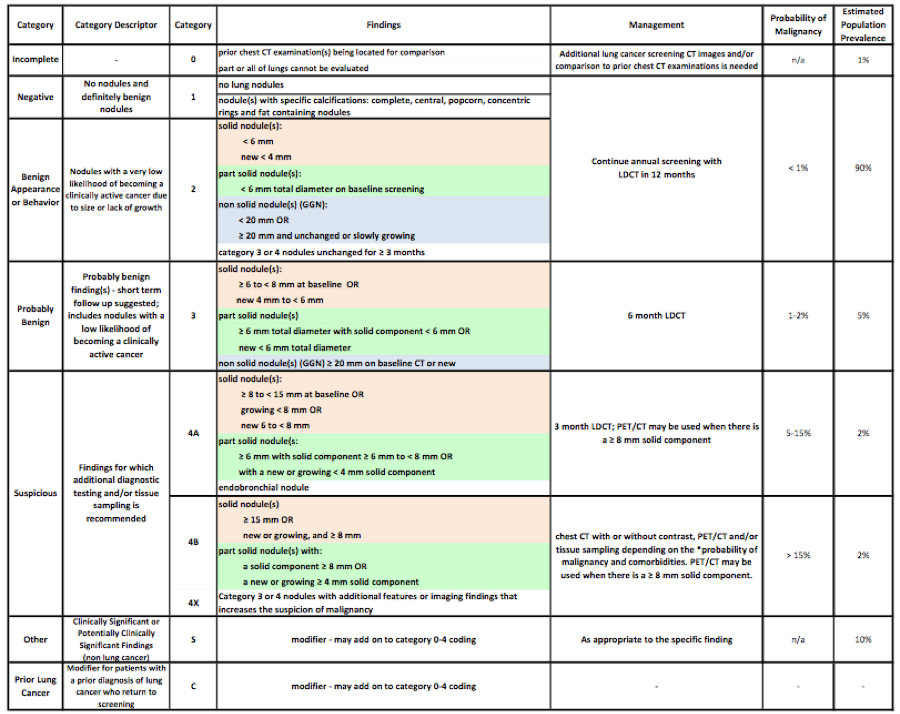
The pictured ACR Lung-RADS matrix is deceiving in its simplicity.  This graphic represents decades of research, advocacy, and hard work from ACR members, staff, government, and academic partners. In my experience, most radiologists focus on the column labeled “Management”. However, few customers, either internal or external, appreciate the weight behind the management recommendations. Their attention, understandably so, tends to focus on the immediate desire to determine malignancy. Radiologists may do well to adopt a patient centered perspective and shift their focus to the column labeled “Probability of Malignancy”. After all, this information speaks to the underlying clinical concern.

Prediction and decision making is fraught with errors; breaking down future management into probabilities is the best way to combat errors and biases. Equipped with the probability information, customers are able to make the most informed decision about future management, thus combating the biases identified in the JACR article. Patients with a high deductible health plan can make rational decisions about when to schedule their next screening exam, if at all. Incorporating the probability information into a standardized Lung-RADS template requires no additional work for the radiologist after a one-time IT investment.

Shared decision making and patient centered care are important concepts changing the landscape of medicine. By increasing patient engagement, we expect better compliance and outcomes. Most customers do not expect radiology participation in this effort yet engagement with a radiologist has a unique power to impact patient experience. By delivering a more patient centered approach to lung cancer screening, we can impress our customers with the unexpected value of our expertise. Delivering probability information to our customers can enhance the value of radiology, rational acceptance of collective management recommendations, and improved morbidity and mortality.

The Importance of Human Resources in Customer Service

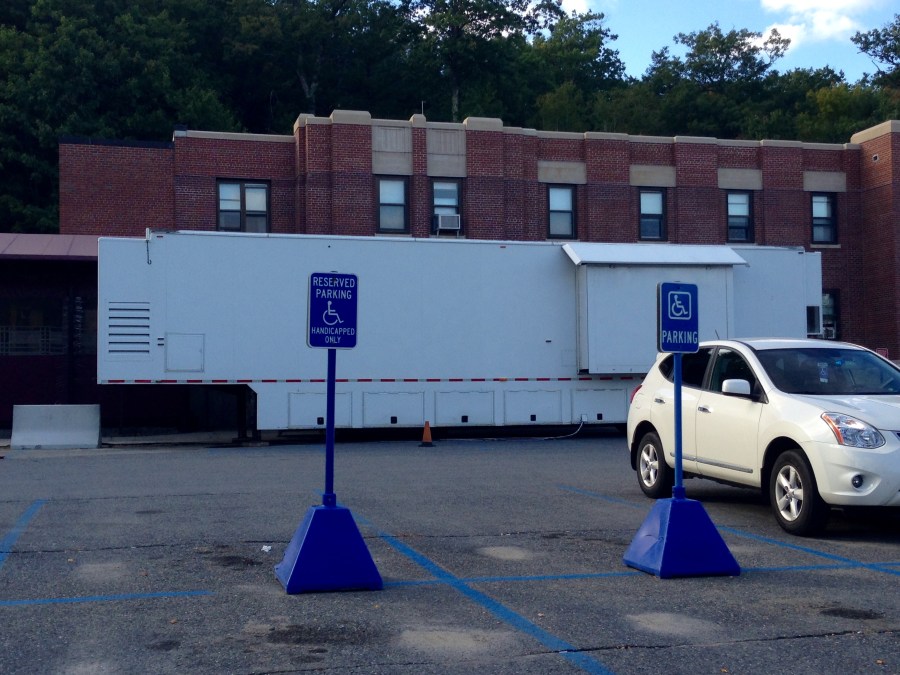
A contracted mobile CT scanner brought in to support a VA hospital CT construction project sits idle in a parking lot due to a lack of human resources. With a rumored cost to taxpayers of approximately $45,000/month there are no technologists available at the institution to run the scanner and provide veteran access to this important imaging service. Furthermore, the absent human resources has prevented timely access to CT services during second/third shifts, and weekends, affecting the Emergency Department and inpatient veterans who need scans. Many of these after-hours studies are being outsourced to a local private hospital, requiring the added cost of ambulance transportation.

Meanwhile, daytime scans are being performed on an in-house low quality 16 slice hybrid SPECT/CT machine, potentially displacing veterans who need nuclear medicine exams.

As the idle mobile CT unit continues to collect dust in the parking lot one employee quipped, “I hope that thing is gone before the snow flies or it will burn.”

Let’s hope it is another mild winter. More attention needs to be paid to the relationship between VA Human Resources and veteran access.  As Human Resources is the link between internal customers (employees) and external customers (veterans and their families), their mission is critical.

Veterans Affairs Mission Statement: Set and Fixed in Metal

I took a course in marketing recently. The first lesson taught was the importance of knowing who you are as an organization. This knowledge, distilled into a mission statement, can serve as the central piece of what should be ongoing internal and external dialogues. If you do not know who you are, you are going to have difficulty with your employees and customers. But this knowledge alone is not enough. When you are not transparent about your needs, values, and intentions it is difficult to partner with anyone, be they the person at the counter, in the next office, or on the other side of your bed.

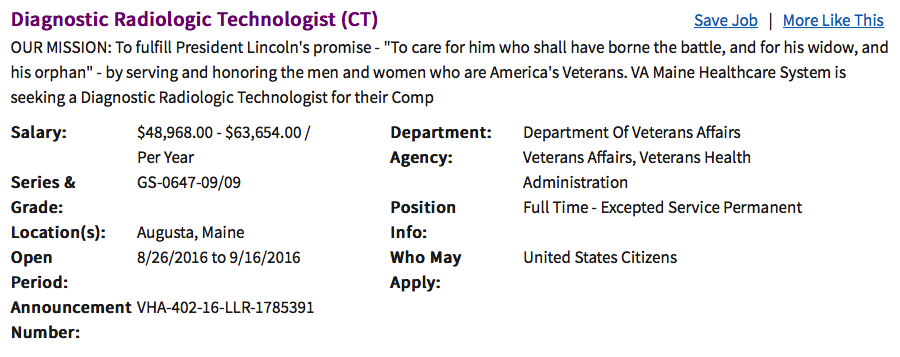
Most hospitals market poorly; this is often a product of not clearly defining, adhering to, or effectively translating their missions. Perhaps it is not surprising that our largest heath care system, the Veterans Administration, often struggles with marketing. Here is the VA mission statement as imbedded in a recent job posting.

Untitled

So, the VA’s mission goes back to the days of President Lincoln. While he may have been our greatest president and one of our greatest leaders, I am sure he knew nothing about modern medicine. Furthermore, the statement relegates women to the role of grieving spouse in a military where only men go into battle.

Thankfully, orphans of veterans are significantly less prevalent today than in Lincoln’s time. The vast majority of our veterans return alive; but the wounded are missing limbs and carry psychological scars that are not easy to diagnose or treat. These injuries greatly impact their families and children in a way Lincoln could not have imagined.

The job posting which carries this mission statement tries to make up for its inherent sexism with the tag line about caring for “the men and women who are America’s Veterans” but succeeds only in making it more awkward and wordy. Our military’s and country’s current values of equal opportunity and modern health care are not supported by this mission statement. How many outstanding healthcare workers and potential employees might be discouraged by its implied lack of sensitivity, or worse, awareness? It is time for our Veterans Administration to update their mission statement. In the process of doing so, they may clarify, inform, and unify their sense of purpose and identity. Distilling this awareness into a clear and concise mission statement may in turn elevate the organization and enhance communication between their employees, within the American culture, and with their veteran customers.